


AI in Education: Opportunities and Risks

Artificial Intelligence (AI) is becoming a growing part of education. From helping students find information to creating learning activities and supporting teachers, AI can make learning more flexible, personalized, and engaging. But just like any tool, AI comes with both opportunities and risks—especially when it comes to children and learning.
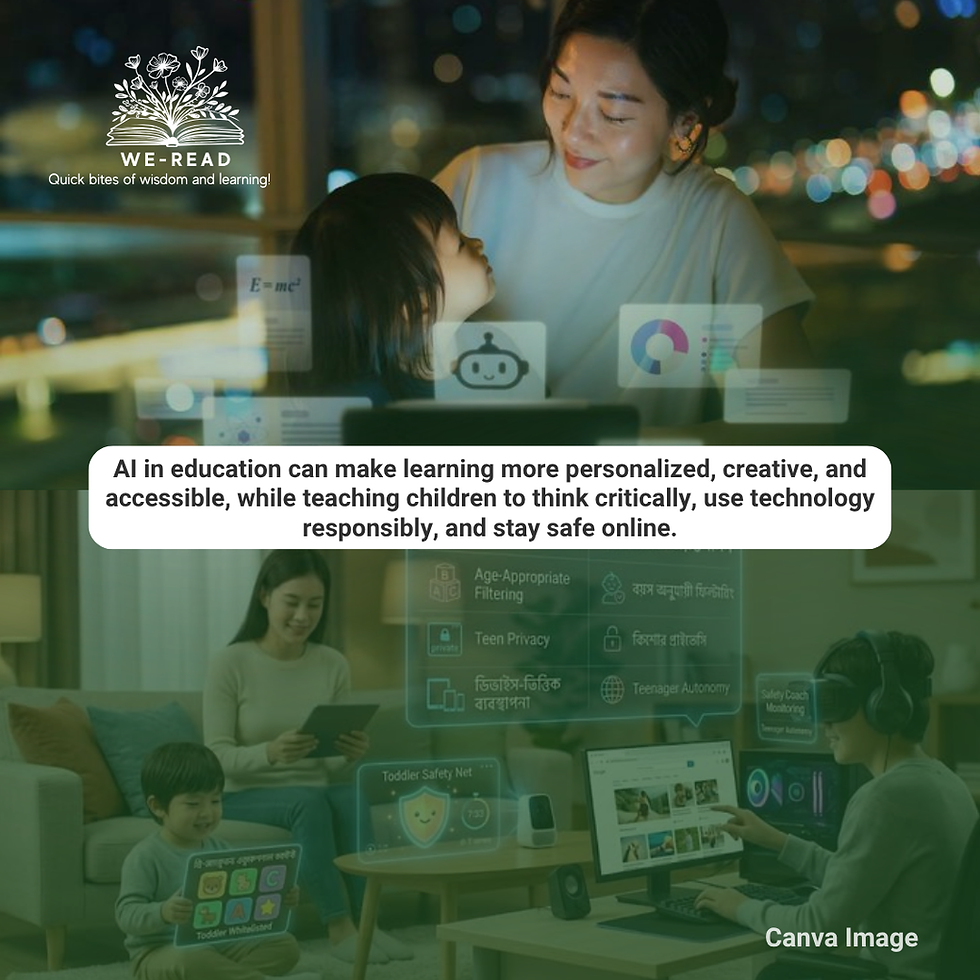
The Opportunities of AI in Education 1. Personalized Learning
Every child learns differently. AI can help provide activities, explanations, and practice exercises based on a learner’s level and needs.
For homeschool families, this can be helpful when one child needs more practice with multiplication while another is ready for more challenging problems.
2. A Helpful Learning Assistant
AI can explain difficult ideas in simpler words, provide examples, create practice questions, and help learners review lessons.
Instead of simply giving an answer, parents can encourage children to ask AI questions such as:
“Can you explain this like I’m in Grade 3?”
This can make challenging topics easier to understand. 3. Supporting Parents and Teachers
AI can help adults prepare lesson ideas, worksheets, discussion questions, quizzes, and educational activities. This can save time and give parents more ideas for making lessons interesting.
However, AI should support the teacher or parent—not replace them.
4. Encouraging Creativity
AI can become a starting point for creative projects. Children can brainstorm story ideas, explore different topics, generate questions, or think of ways to present what they have learned.
The important part is that the child still creates, thinks, decides, and expresses ideas independently.
⚠️ The Risks We Need to Consider
1. Too Much Dependence on AI
One of the biggest concerns is when learners use AI to do the thinking for them.
If a child always asks AI for the answer, they may miss opportunities to practice problem-solving, critical thinking, writing, and decision-making.
👉 The goal should be: “Use AI to help me learn,” not “Use AI to do my learning for me.”
2. Incorrect Information
AI can sometimes provide information that sounds convincing but is incorrect. Children may not yet have enough knowledge to recognize mistakes.
That's why learners should be taught to check information using trusted books, teachers, parents, and reliable sources.
3. Less Independent Thinking
Education is not only about getting the correct answer. It is also about learning how to think. If students rely too heavily on AI-generated answers, they may have fewer opportunities to struggle productively, make mistakes, ask questions, and develop their own ideas.
4. Privacy and Online Safety
Children should never casually share personal information with AI tools or other online services. Parents should teach children to protect information such as their full name, address, passwords, school details, photos, and other private information.
5. Academic Honesty
AI can make it easy for students to submit work they did not actually create.
For example, asking AI to write an entire essay and submitting it as their own may prevent the learner from developing important writing skills.
Instead, AI can be used for brainstorming, reviewing, practicing, or getting feedback while the learner remains responsible for the final work.
🏡 AI and Homeschooling: Finding the Balance
For homeschooling families, AI can be a useful learning companion, but it should not become the teacher, parent, or student.
Parents can create simple family rules such as:
✅ Try the problem yourself first.
✅ Use AI to explain—not simply answer.
✅ Check important information.
✅ Never copy and submit AI-generated work as your own.
✅ Protect personal information.
✅ Talk with a parent or teacher when something is confusing.
✅ Spend time learning without screens, too.
💡 A Simple Rule for Kids:
“Think first. Ask AI second. Check the answer. Learn from it.”
🌱 The Future of Learning
AI is not simply about technology. At its best, it can give learners more opportunities to explore, ask questions, practice, and discover. But children still need something AI cannot replace: human connection, guidance, values, curiosity, creativity, and the experience of learning through real life.
For parents and educators, the goal isn't to keep children away from AI completely. Instead, we can teach them to use it wisely, safely, responsibly, and ethically.
Because the most important skill isn't simply knowing how to use AI.
It's knowing when to use it, how to question it, and when to think for yourself. 🤖🧠📚
AI should be a tool in a child's learning journey—not a shortcut around learning.
When used thoughtfully, AI can open new doors for education while still keeping the child at the center of the learning experience. 💛


Comments