


United in Love: Why Parents Must Stand Together in Raising Their Children
- Welearn Center
- 2 minutes ago
- 4 min read

"Can two walk together unless they have agreed to do so?" — Amos 3:3
One parent says "yes." The other says "no."
One believes in gentle conversations. The other prefers strict discipline.
One wants to give another chance. The other believes consequences should come immediately.
If this sounds familiar, you're not alone.
Every parent comes into marriage carrying different experiences, values, and expectations. We were raised by different families, shaped by different cultures, and taught different ways of expressing love and discipline. It is natural for couples to have different parenting styles.
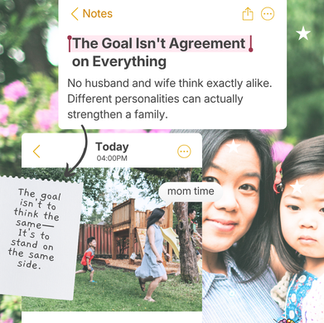
The problem is not that parents are different.
The problem begins when those differences divide the family instead of strengthening it.

Children Need Security More Than Perfect Parents
Children thrive when they know what to expect. Consistent rules, expectations, and responses help them feel emotionally safe.
When parents constantly disagree in front of their children, children may become confused about boundaries. Some may begin testing limits by asking the parent they believe will say "yes." Others may feel anxious because they are unsure whose instructions to follow.
Research consistently shows that children benefit when parents present a united approach to parenting. Consistent parenting has been associated with better emotional regulation, stronger family relationships, and fewer behavioral problems. On the other hand, frequent conflict between parents—especially about child-rearing—has been linked to increased stress, anxiety, and behavioral challenges in children.
Children do not need parents who agree on everything.
They need parents who choose to work together.




What Research Says About United Parenting
Modern psychology supports what Scripture has long taught.
Research on coparenting consistently shows that when parents cooperate, communicate, and support each other's decisions, children experience:
Better emotional regulation
Stronger academic performance
Higher self-esteem
Fewer behavioral problems
Reduced anxiety and stress
Healthier relationships later in life
Studies published in the Journal of Family Psychology and research from the American Psychological Association have found that conflict between parents about parenting—not simply having different parenting styles—is linked to increased emotional and behavioral difficulties in children.
Children thrive when expectations are predictable.
Consistency builds security.
Different Doesn't Mean Wrong
Many parents worry:
"We're so different. Are we doing this wrong?"
Not at all.
In fact, children often benefit from seeing both compassion and discipline.
One parent may naturally encourage emotions.
The other may help build resilience.
One teaches patience.
The other teaches responsibility.
When these strengths are united under shared family values, they become powerful.
Problems begin only when parents compete instead of collaborating.
Signs Parents Need to Reconnect
Consider reflecting together if you notice these patterns:
Your child asks the "easier" parent after hearing "no."
Rules change depending on who is home.
You frequently correct each other in front of the children.
Your child says, "Dad said yes," or "Mom won't let me."
Parenting discussions often become arguments.
These moments aren't failures.
They're invitations to reconnect.
Practical Ways to Become a United Parenting Team
1. Agree on Your Family Values
Before discussing rules, discuss your purpose.
Ask:
What kind of adult do we hope our child becomes?
Which Christian values matter most?
What behaviors do we want to encourage?
When values become the foundation, decisions become easier.
2. Discuss Disagreements Privately
Children should never feel responsible for choosing sides.
If you disagree:
Pause.
Talk privately.
Pray together.
Then return with one shared decision.
3. Create Family Non-Negotiables
Choose a few expectations everyone agrees on.
Examples:
We speak respectfully.
We tell the truth.
We help one another.
We pray before meals.
We apologize when we make mistakes.
Consistency is more important than having many rules.
4. Support Each Other Publicly
Even if you would have handled a situation differently, avoid correcting your spouse in front of your child.
Later, discuss improvements privately.
Your child gains confidence when they know both parents are on the same team.
5. Extend Grace
No parent gets everything right.
There will be stressful days, misunderstandings, and moments of exhaustion.
Offer each other the same grace God gives us every day.
Remember: your child doesn't need perfect parents.
They need parents who keep growing together.
Family Activity: Building Our Parenting Team
Set aside 30–45 minutes this week after the children are asleep.
Together, answer these questions:
What are three qualities we hope our child has as an adult?
Which parenting moments have gone well recently?
Where do we often disagree?
How can we better support each other?
What is one parenting goal we can work on this month?
Write your answers somewhere visible.
Pray together before ending your conversation.
Family Challenge: The United Front Week
For the next seven days:
Pray together for five minutes each day.
Discuss parenting concerns privately.
Encourage your spouse at least once daily.
Present every important decision as a shared decision.
End each day by thanking God for one parenting victory, no matter how small.
At the end of the week, celebrate with a family meal or game night.
A Prayer for Parents
Heavenly Father,
Thank You for entrusting these precious children to our care.
Teach us to love as You love.
Help us speak with kindness, lead with wisdom, and discipline with grace.
When we disagree, give us humble hearts that seek understanding instead of winning.
May our home reflect the unity of Christ, where love is patient, forgiveness is quick, and every child feels safe, valued, and deeply loved.
Strengthen our marriage so that together we may raise children who know You, love You, and shine Your light wherever they go.
In Jesus' name,
Amen.
Parenting is not about having the same personality.
It is about sharing the same purpose.
When parents stand together in love, guided by Christ and committed to growing as one, they create a home where children flourish—not because everything is perfect, but because love, grace, and unity are present every day.
"Above all, clothe yourselves with love, which binds us all together in perfect harmony." — Colossians 3:14

Comments